DOS HERMANOS: GO EVERYWHERE, EAT EVERYTHING

"It's not much but it's ours"

Thursday, April 07, 2011

MALABAR SEAFOOD CURRY: A LITTLE BIT OF KERALA IN LA


After a few days of pretty good eating in the peachy state of Georgia (Savannah post soon come), our return home left us wanting not only a bit of comfort eating, but also in one of those all too rare moods where meat was not top of the agenda.

It was Sybil who suggested we use up a few bags of frozen prawns and scallops lurking at the back of the freezer and, when that was combined that with my own urge for something with a little bit of spice, it had me reaching for this terrific recipe for Malabar Seafood curry given to me by a friend from the southern Indian state of Kerala.

The use of coconut is very typical of many dishes from the area and you could substitute the shrimps and scallops that I used for white fish or other types of seafood. I have made similar dishes with clams, mussels and even chunks of lobster and crab. The key to a great end result is to poach the seafood in the sauce towards the end of the cooking time so that it does not over cook and become tough.

Some versions call for tamarind to be added as a souring agent. While that can be delicious, I find that the addition of fresh lime juice at the very end of the cooking time achieves much the same affect and gives an added freshness to the dish, as indeed does the garnish of grated lime zest.

Definitely worth a try.

INGREDIENTS (Serves 4)
12 Large Shell On Shrimp
5 Large Scallops (sliced into three discs)
1 13oz Can Coconut Milk
1 Can's Worth Of Water
½ Large White Onion (sliced)
3 Cloves Garlic (peeled and minced)
3 Green Chillies (seeded and minced)
1 Inch Fresh Cinnamon Stick
1 Inch Fresh Ginger (peeled and minced)
½ Tsp Fenugreek Seed
½ Tsp Mustard Seed
3 Green Cardamom Pods
1 Tsp Ground Coriander
1 Tsp Ground Turmeric
1 Tsp White Pepper
1 Tsp Salt
1 Tsp Sugar
1 Lime (juice and zest)
Vegetable Oil For Cooking


METHOD
Heat the oil in a large, deep sided frying pan.
Add the fenugreek seed, mustard seed, cinnamon stick and cardamom pods and fry for two minutes to allow them to flavour the oil.
Add the minced ginger, chilli and garlic and sweat for a few minutes until they begin to lose their raw smell.
Add the sliced onion and cook until soft and golden.
Combine the salt, sugar and ground spices and mix with a little water to form a paste.
Add to the pan and combine well with the existing contents.
Cook for five minutes until the spices begin to release their oils.
Add the can of coconut milk and the same amount of water.
Stir well and bring the sauce to a simmer.
Allow the sauce to cook until the contents of the pan have reduced by half.
Add seafood and poach gently until it is cooked.
Add the juice of one lime an stir in gently
Spoon into a serving bowl and sprinkle with lime zest.
Serve with plain boiled white rice and, if you can find them Appams or “hoppers” as they are known (rice flour batter pancakes)

Labels: , , ,

Stumble Upon Toolbar

Wednesday, December 08, 2010

SOUTH KOREA: BUSAN


I loved my time in Seoul. However, if a gun was placed against my head, I would have to admit that I enjoyed my time in the country’s second city, Busan (Pusan?) even more.

It is not a small place, with a population of nearly four million people. But, it has a small town, almost provincial feel that offered a welcome respite from the megatropolis that was the nation’s capital. It also exudes a more earthy air, hardly surprising as it is a port city and for centuries one of the first places that foreign visitors to the Joseon kingdom would come to ply their trade, which made for what was regarded as an edgy and dangerous place.

Those days are all but gone, but some legacies remain. Across the city, you find signs indicating that the shop owners speak many languages. Not for the foreign tourists, of which there are relatively few but for sailors from the many ships, which find berth in the still bustling harbour. There is also one more legacy, far more interesting for the food enthusiast. Busan is home to the Jalgachi (literally village by the shore) fish market, which is second in size only to Tsukiji in Tokyo and the wafts of fishy scent from the mongers and restaurants lay heavily over the lower reaches of the city.

We arrived from Seoul after an short two hour journey on the excellent K-Rail connection between the two cities and, after dropping our bags off at the rather eccentric hotel we had chosen, went out to visit the area around the port. The main fish market, of course, only comes to life in the early hours of the morning. However, surrounding the main building are alleyways filled with restaurants, in front of which are tanks from which you can select your live fish or seafood to be prepared to your liking.

Next to the Jalgachi, is a six-storey building called Shindonga, which houses vast numbers of fishmongers who offer the same service. Cases of live fish are situated next to bright yellow tables. While elderly women bark out to attract customers, the apron clad owners scoop the fish from their water baths and dispatch them with a efficiency that can only come from years of practice.

It’s not cheap, but then great seafood never is and, after treating ourselves to a simply grilled snapper, we headed back towards the main town in search of something more substantial. We found it in the form of Samgyetang, a small chicken, stuffed with rice and fresh ginseng and poached in a close fitting container to form a light broth. While Syb found it a little bland, for me it was one of the eating highlights during our whole time in Korea and definitely a dish that I intend to make at home in the near future.

After a slightly fitful night’s sleep, we awake at 5am and went straight out to the fish market. It was certainly impressive, compared to some I had seen, but paled in comparison to Tsukiji (as I suspect any market I ever visit always will) and we were soon headed back to our hotel to catch up on some much needed rest.

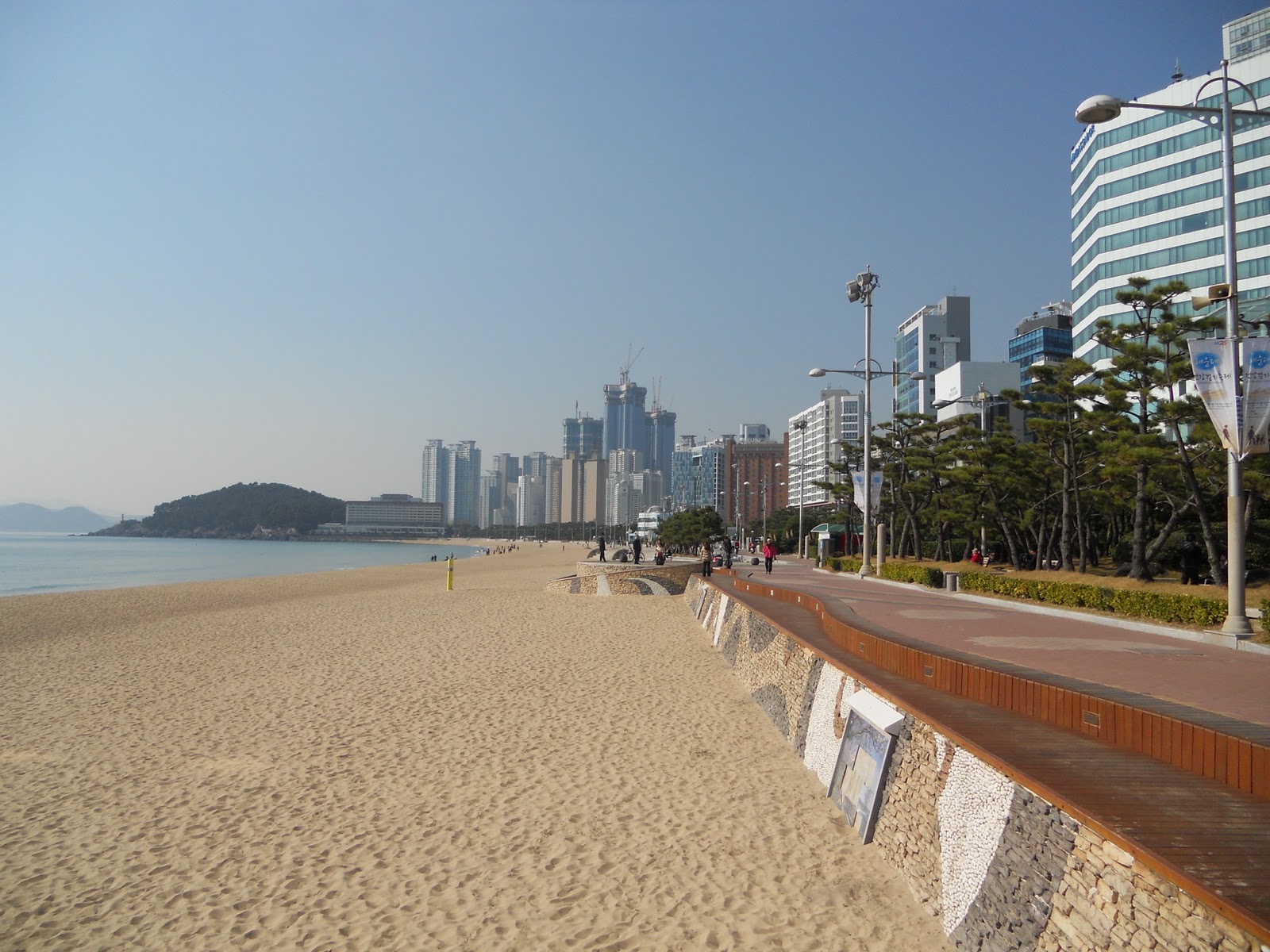
As in Seoul, our time in Busan was limited and we wanted to fit in as much as was humanly possible. Close to Busan and very accessible by use of its limited but efficient subway system, are a number of beach resorts where locals and Korean tourists spend their vacation time. One of the largest is Haeundae, a few miles to the East of the city.

Unsurprisingly, in November, few locals had chosen to spend their day on the windswept beach, which left us pretty much to our own devices as we strolled along the promenade. Towards the end of our walk and just when our stomachs were reminding us that we had not yet had lunch, we came upon a smart restaurant called HaeunMaru, which later research revealed to be one of the best fish restaurants in the region.

Even if we had not done the research, it would have been very clear that this was no ordinary fish restaurant. Prices were not for the faint hearted, at over $100 for two. But, the quality of the food on offer made this one of the best meals of the whole vacation. We began with a tray of assorted raw seafood, including abalone, conch, oysters, shrimps and clams. All were breathtakingly fresh and all (apart from the oysters which I avoided for fear of death) as good as any I have ever tried. These came alongside dishes of excellent banchan and a bowl of steaming Chawanmushi, the savoury egg custard I had become such a fan of during my time in Japan.

Next up, a plate of fresh local fish which had been simply grilled and given a dousing in lemon juice before being served to us at the table. While we ate the flesh, the bones were taken away and used to make a thin, spicy fish soup bulked out with noodles and sliced spring onions. A fantastic end to a meal, which confirmed everything I already love about Korean food.

By the time we returned to the city, it was already dark and we spent our last evening in Korea walking through the streets thronged with kids as we decided on where to have our last meal or snack of this part of the trip. We noticed that one particular street stall appeared to be much busier than all the rest and joined the queue to find out what all the fuss was about.

At the head of the line, a short, plump woman was wrapping dough around a filling of brown sugar, honey and cinnamon before frying them on a hot plate until golden brown on both sides. When they were ready to be served, she placed them in a paper cup, split the top and then filled the cavity with roasted peanuts and sesame seeds. These were Ho-tteok and were certainly a sweet treat. Perhaps too sweet for me, but Sybil loved them and talks about them still.

Fitting enough that our last day in the energetic city of Busan, indeed our last day (for now) in Korea would offer up two of the best tastes of a week’s worth of incredible eating. Enough for certain to ensure that we both are certain we would like to return and discover more of what Korea has to offer.

In the meantime, however, the vacation was only just beginning and we were off to Singapore and Malaysia.

More anon.

Labels: , , ,

Stumble Upon Toolbar

Thursday, March 25, 2010

THE BOILING CRAB: BOIL IN THE BAG IN ALHAMBRA


As I worked on EATING FOR BRITAIN, the impact of trade and immigration on the cuisine of our nation became more and more apparent. Without Phoenician traders Cornwall would not have clotted cream or saffron. Without Portuguese Jews and Belgian Huguenots being tossed from their respective lands we would have no fish and chips, and without the British Empire, we would have nowhere to go to after half a dozen pints on a Friday night.

America too has its own legacy and in the late 1970’s the US extended their hospitality to over 800,000 Vietnamese Boat People. Many of these refugees were settled in the Southern states where, over the last thirty years, they have begun to assimilate with the local communities with some interesting culinary consequences.

There is a point to all of this, in case you were wondering, and that point is The Boiling Crab, where Sybil and I along with our friend Amanda had lunch on Sunday. The Boiling Crab is a small chain of eight restaurants, which originated in Seadrift, Texas and now also has four locations in California.

The owners are originally from Vietnam (ah, there’s the link) and have combined their own traditional take on seafood with the “crab boils” which are so popular throughout the coastal towns of the South. In the short time they have been open, the restaurants have become incredibly popular and, with their no reservation policy, tales of the waiting time to get a table, are legion on local food blogs.

We headed East to Alhambra, an area that like its neighbours, Arcadia and Monterey Park is home to large communities from across South East Asia and consequently to some of the best restaurants representing their cuisines in the city. We arrived early enough to be first in line, but soon found ourselves heading up a queue of little short of a hundred people.

It wasn’t the orderly sort of line we are used to back in Britain, and I have to admit to being a little uncomfortable as people milled around not following the norms of good queuing that have been inculcated into Brits over generations. However, it all seemed to work in its own chaotic way and, after taking our names a short while before opening, we were the first to be shown to a table as soon as the doors were pushed back.

The Boiling Crab is no fine dining establishment. The tables are covered with paper, rolls of Costco’s finest kitchen towel are the only adornment and, as soon as I took a seat, a waiter arrived with a plastic bib for each of us. The menu too is short and, Amanda being Amanda and Sybil Being Sybil, they already knew what we were going to order by the time I returned from a visit to the bathroom.

The restaurant, as its name suggests is all about seafood and ordering is simple. You choose your variety (from Shrimps, Crayfish, Lobster, Blue Crabs etc etc), which are boiled in a bag along with a range of sauces and at different levels of spiciness. We ordered ours in a medium hot sauce and also added a couple of side dishes and a portion of catfish. We then sat back to sip on our drinks as we waited for our food and watched the floorshow as the rest of the small restaurant began to fill up.

The first part of our order arrived about ten minutes later. A plastic bag filled with a lurid orange sauce was opened to release a waft of savoury, spicy seafood steam. The sauce was coating 1lb of shrimps and we immediately fell on them sucking the heads to remove all the fat. Sybil and Amanda peeled their shrimp carefully, I on the other hand ate them shell and all. It is something I have always done and so do most of my family. I think it is a texture thing.

By the time we had finished half the shrimp leaving a mound of shells and heads on the table, our next orders arrived. The catfish was freshly fried in a breading crust and piping hot as it nestled on top of some spiced up fries (there is a theme here) and we tossed chunks between our hands until they were cool enough for us to break apart releasing the white flakes of fish underneath. We dipped them in the bag mopping up the remaining sauce from the shrimps.

Then came the next bag, this time containing two blue crabs. I was less taken with these and not just because I have barely been able to look at a crab since I spent seven hours projectile vomiting on a crab boat off the coast of Cromer last year. The truth is that crabs are often found wanting when it comes to the “effort:reward” ratio. These were no different and, while Sybil and Amanda seemed to enjoy the effort of smashing the claws to release tiny, sweet shreds of flesh, it all seemed like too much of a faff for me and I picked at a pile of sweet potato fries while finishing off the last few remaining shrimps.

Regular readers of the blog will know that there does not appear to be a word for “ample” in Tagalog or, if there is, Sybil has never bothered to learn it. So, no sooner was she wiping her mouth clean of crab juices, she and Amanda were waving over the waiter to place orders for more seafood, in this case an extra pound of shrimps and pound of the most expensive items on the menu, King Crab Legs.

Like the Blue Crab, the $17.99 a lb limbs of the King variety left me cold. However, as the pictures show, they were greeted with considerable glee by Amanda who was happy to leave the new bag of spicy shrimp to me to polish off and then use as a dip for the remaining fries.

Less than an hour after we arrived, we had laid waste to over four lbs of seafood and the waiter came to clear our table with an approving nod and a shout of “Good Job”. Bear in mind however that while our efforts were laudable, he also informed us that single diners have been known to polish off 5lbs of shrimp or crayfish in one sitting. No doubt this induces some form of seafood coma similar to the one we felt as we waddled out to the parking lot.

The line seemed to have doubled while we were in there and I can certainly understand why. The Boiling Crab serves up tasty food and a fun experience for a ludicrously cheap price. Our whole meal was less than $30 a head including drinks and tip, representing excellent value for some wonderfully messy silliness.

I am not normally a fan of fusion cuisine, but after one visit to The Boiling Crab, Vietnamese Cajun is marked down as one of the more unlikely successes.

Who knew?

Labels: , , , , , , ,

Stumble Upon Toolbar

Thursday, September 17, 2009

BACK IN LA: MORE MEXICAN MARISCOS


Since HP has just returned from Spain where he seemed to devote much of his time contributing to a future shortage of seafood, I thought it was only right and proper that I try to do the same while here in Los Angeles.

So, when Sybil returned home from work and suggested we head straight out for supper at a Mexican mariscos restaurant she had read about on that splendid blog,EATING LA I was only too happy to comply.

Mariscos Chente in Culver City specialises in dishes from the Sinaloa and Nayarit states of North West Mexico. The cuisine was a new one on me and focuses on seafood and fish. The owners apparently fly to Mexico every week bringing back many types of fish not readily available in the US.

The restaurant is not a particularly prepossessing place. The walls are bare but for a few posters. There is a distinct absence of air conditioning and Mexican football blares out from two televisions attached to the wall. If the room is sparse, so too is the menu, split into four sections featuring a range of shrimp dishes in various sauces, a selection of the raw coctels that were one of the highlights of my time in Guadalajara, ceviches and a handful of fish dishes.

What it lacks for I choice, it makes up for in quality. After we had worked our way through the best part of a bowl of crunchy tortilla with a thin salsa of coriander leaf, chilli and lots of lime, our first dish arrived. Camarones Borrachos were thick and meaty shrimps served in a sauce spiked out with chunks of garlic and laced with a hefty amount of tequila. We divided the shrimp equally and then fought over the heads sucking the fat from them before mopping up the remaining sauce with grains from mound of buttery rice.

Less successful was a dish of Chicharron De Pescado, which shrieked of pre-preparation. The tough outer shell tasted as if it had been refried from a lunchtime batch and the dry fish flesh inside was barely worth the effort required to excavate it. Dipping it in the dish of green salsa perked it up a little, but the fact that we left more than half the plate spoke volumes.

Fortunately, things got back on track with our final selection. Pescado Serandeado turned out to be a whole snook, split and marinated in “Salsa Inglese” (that’s Worcestershire Sauce to you and me) and then grilled until the skin had become crisp. It was served with a few soft corn tortilla and a bowl of sharp caramelised onions. It’s stunning stuff, and we after we had finished the fatty belly meat of the fish, Sybil picked up the bones to suck them clean of the remaining flesh.

It is not cheap, but for seafood of this quality, $64 including tip struck me as remarkably good value, particularly as it represented an introduction to a part of Mexico that is little represented in L.A dining and almost unknown in the UK.

As we left the restaurant we saw signs on the wall, which read, “Try Langostino” We had not realised that these were available to order off menu. The decision was made, we would simply have to return again later during my trip.

I trust that Hermano Primero would be suitably pleased that I am keeping my end up, seafood wise

Labels: , , , ,

Stumble Upon Toolbar

‹Older